Imagine this: your organization invests thousands in wellness programs, yet only a fraction of employees participate. Low turnout not only wastes resources but also misses opportunities to enhance productivity, reduce absenteeism, and foster a healthier workforce. The challenge lies at the heart of employee engagement in wellness programs, where good intentions often fall short of real impact.
As HR leaders and program managers seek sustainable solutions, understanding the drivers of participation becomes critical. This analysis delves into evidence-based strategies that transform passive offerings into must-join initiatives. Drawing from industry benchmarks, case studies, and behavioral science, we examine tactics such as personalized incentives, gamification, leadership buy-in, and seamless integration with daily workflows.
By the end of this post, you will gain actionable insights to diagnose engagement gaps in your programs, implement high-impact interventions, and measure success through key metrics. Elevate your wellness efforts from obligatory to irresistible, and watch as engaged employees drive lasting organizational benefits.
The Current State of Wellness Program Participation
Despite widespread adoption, employee engagement in wellness programs remains alarmingly low. Data from Select Software Reviews and Meditopia’s 2026 analysis reveals that 85-87% of organizations offer wellness initiatives, yet average participation rates linger at just 20-35%. This disconnect persists even as 74% of companies plan budget increases for wellness, highlighting a fundamental gap between program availability and actual uptake. Employee Assistance Programs (EAPs) show even poorer utilization at 5-10%, underscoring systemic challenges in driving participation.
Key Barriers to Participation
Several barriers impede progress, directly affecting employee health and retention. Lack of time tops the list, cited by 50-61% of employees due to heavy workloads and skipped breaks. Poor communication affects 34%, with jargon-heavy messaging and low awareness leaving 70% unclear on benefits. Program irrelevance alienates 37%, as generic offerings fail diverse needs like mental health apps for younger workers or stress tools for parents. Mental health stigma compounds this, with 43% fearing career risks from seeking help. These issues fuel burnout (77% affected) and higher turnover.
Implications for HR Professionals
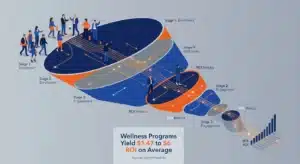
For HR leaders, low uptake erodes culture of wellness efforts and squanders opportunities to cut healthcare costs, projected to rise 7% in 2026. Programs promise $1.47-$4 ROI per dollar invested, yet disengagement leads to 1.5 extra sick days per employee annually and 11% higher attrition. Only 69% of organizations see retention gains from strong initiatives, demanding better strategies.
The global wellness market’s growth to $100 billion by 2026 (Wellsteps) amplifies urgency. HR must adopt personalized, tech-driven engagement to unlock benefits like 28% higher workplace engagement and reduced absenteeism.
Key Benefits of Higher Employee Engagement
Higher Workplace Engagement and Reduced Absenteeism
Organizations that boost employee engagement in wellness programs unlock substantial productivity gains. Participants report 28% higher workplace engagement, according to Hirex’s analysis of employee wellness statistics. This heightened motivation stems from programs that address physical, mental, and emotional needs, creating a more dynamic work environment. Furthermore, these initiatives lead to up to 28% fewer sick days, with an average reduction of 1.5 days per employee annually, as corroborated by Meditopia’s research. HR professionals can leverage this by prioritizing accessible, personalized challenges that fit busy schedules. The result is a workforce that shows up consistently, minimizing disruptions and fostering a culture of wellness.
Stronger Retention Through Perceived Care
Feeling valued directly ties to loyalty, with wellness programs serving as a powerful retention tool. Employees who perceive genuine employer care about their well-being are 34% more likely to stay, per WebMD Health Services’ workplace wellness trends. Additionally, 69% of organizations report retention improvements after implementing such programs, as employees associate comprehensive support with long-term commitment. This effect is particularly pronounced among younger demographics, where mental health resources influence stay-or-go decisions. Actionable insight: integrate pulse surveys to gauge sentiment and refine offerings, ensuring programs evolve with employee needs. Ultimately, this builds a resilient culture that retains top talent amid competitive labor markets.
Performance Improvements and Impressive ROI
Wellness engagement translates into measurable performance uplifts. Between 60% and 70% of employees credit these programs with enhancing their on-the-job effectiveness, driving higher output and innovation. Select Software Reviews highlights returns of $1.47 to $4 for every $1 invested, through lower burnout and sustained energy levels. HR leaders can maximize this by tracking metrics like participation rates and productivity scores pre- and post-implementation. Programs with gamification and rewards amplify these gains, creating self-reinforcing cycles of motivation.
Lower Healthcare Costs and Surging Investments
By promoting better employee health, engaged wellness programs slash healthcare expenditures. Preventive measures cultivate a proactive culture, reducing claims related to chronic conditions and stress. EPIC Brokers notes that 41% to 74% of employers plan spending increases over the next 1-2 years to capitalize on these savings. This strategic shift underscores wellness as a fiscal imperative, linking individual health to organizational ROI. For population health managers, customizable platforms enable targeted interventions, ensuring scalability and impact.
Overcoming Common Barriers to Participation
Despite 85-87% of organizations offering wellness programs, average participation lingers at 20-35%, hampered by barriers like time constraints, perceived irrelevance, communication gaps, mental health stigma, and motivation deficits. These obstacles not only undermine employee health and engagement but also inflate healthcare costs and erode retention, with disengaged workers 34% more likely to leave. Addressing them requires targeted, data-driven strategies that foster a culture of wellness. Platforms with adaptive technology enable customization, streamlining administration while boosting outcomes through personalization and integration.
Addressing Time Constraints and Irrelevance
Busy schedules and hybrid work models (52% of workforces) often sideline rigid programs, while one-size-fits-all offerings fail to resonate, particularly for lower-income employees facing competing priorities. Flexible hybrid formats, blending digital on-demand classes with in-person options like gym reimbursements, accommodate diverse needs and have doubled participation in leading initiatives. AI-driven plans analyze user data to deliver tailored goals, nudges, and coaching, with 75% of programs integrating wearables for real-time tracking. For instance, employees receive personalized weight management or preventive health paths, aligning with 72% broker priorities for preventive care. This approach yields 20% higher productivity and 16% greater satisfaction, per recent analyses, while reducing sick days by up to 28%. HR leaders can implement micro-sessions (10-15 minutes) via secure apps to fit seamlessly into workflows.
Bridging Communication Gaps
Overwhelming or jargon-laden messaging leads to information overload, with benefits satisfaction at just 61%. Pulse surveys, used by only 17% of programs, offer real-time feedback to refine communications, yet their adoption reveals untapped potential for sentiment analysis. Leadership buy-in proves 72% effective, as visible executive participation in launches and challenges builds trust and psychological safety. Multi-channel strategies, including infographics and SMS with A/B testing, elevate open rates significantly. Actionable step: Train managers quarterly and deploy weekly pulse checks to sustain dialogue, mirroring trends that enhance overall engagement by 56%. Check Wellable’s 2026 Trends Report for benchmarks.
Combating Mental Health Stigma
Stigma deters 68% of workers from seeking help, exacerbating burnout (66% prevalence) and healthcare expenses. With 76% of organizations ramping up mental health investments, secure, anonymous platform features like third-party data handling and AI therapy chats dismantle barriers. On-demand coaching and EAP enhancements ensure privacy, reducing underuse. Inclusive tiered models normalize access, cutting burnout by 37% when support feels genuine. Professionals should prioritize ethical AI for proactive resilience tools.
Leveraging Incentives and Gamification
Rewards motivate where access alone fails; 88% of programs deploy them, with gamified challenges via wearables doubling participation in high-success cases. Points, badges, and stipends tied to progress foster sustained habits, delivering 89% happier employees and 3:1 ROI. Integrate leaderboards with intrinsic trackers for retention gains. See Corehealth’s participation challenges guide for implementation tactics.
By dismantling these barriers, companies cultivate engaged, healthier workforces, slashing costs and turnover.
2026 Trends Driving Wellness Engagement
As organizations grapple with persistent low participation rates of 20-35% in wellness programs, 2026 trends signal a pivotal shift toward strategies that elevate employee engagement in wellness programs. Drawing from Wellable’s 2026 Employee Well-Being Industry Trends Report, HR leaders are prioritizing holistic, tech-enabled approaches to address burnout, retention challenges, and rising healthcare costs. These evolutions promise to transform wellness from a perk into a measurable driver of culture and productivity, with 60% of brokers anticipating increased spending despite economic headwinds. By focusing on preventive, interconnected wellness pillars, forward-thinking programs can yield 28% higher workplace engagement and up to 28% fewer sick days, building directly on the benefits of overcoming common barriers.
Holistic Wellness: Preventive Health, Financial Wellness, and Weight Management
A core 2026 trend is the expansion of holistic wellness, recognizing the interplay between physical, mental, and financial health to foster sustained participation. Preventive health leads with 72% of brokers expecting investment growth, emphasizing accessible screenings, health literacy, and physician engagement to curb chronic conditions affecting 58% of workers. Financial wellness surges with 55-92% adoption rates, up 11% year-over-year, as employers integrate EAP expansions, loan repayment, and planning tools; this addresses economic stress linked to mental health for 75% of employees missing savings goals. Weight management follows closely at 76%, propelled by GLP-1 medications paired with behavioral coaching for obesity and diabetes management. Actionable insight: Customize programs with modular content to boost relevance, potentially reducing financial stress by 32% and enhancing retention by 34%. DHR Global’s Workforce Trends Report underscores how such integration counters declining engagement to 64%.
Tech Integration: Wearables, AI, and Single-Platform Solutions
Technology integration is revolutionizing employee engagement in wellness programs, with 75% of employers adopting wearables and AI for personalization. Fitness trackers and smart devices, synced via platforms like Apple Health, provide real-time feedback and gamification, while AI tailors recommendations to individual needs, doubling uptake in hybrid models. Single-platform hubs centralize challenges, analytics, and administration, slashing fragmentation and enabling seamless HR integration for streamlined operations. For HR professionals, subsidizing devices and prioritizing data privacy can accelerate adoption; preliminary data shows these tools foster health cultures and ROI of $1.47-$4 per dollar invested.
Engagement Boosters Amid 66% Burnout Rates
To combat 66% burnout rates costing $4,000-$20,000 per employee, 2026 emphasizes challenges, peer recognition, and feedback loops. Leadership participation in 72% of programs, 88% rewards usage, and pulse surveys drive motivation, with only 17% currently collecting ongoing input; experts recommend AI-analyzed polls for rapid iteration. These tactics, alongside stress tools and mindfulness, elevate participation in lifestyle programs preferred by 72%. Rising costs as a top stressor amplifies urgency, linking wellness to morale.
Economic Pressures and Evolving ROI Metrics
Facing healthcare hikes, 59% prioritize cost management, yet shift to Value on Investment (VOI) metrics beyond absenteeism, with 70% tracking engagement and retention. This holistic ROI focus, measuring morale and productivity, aligns with market growth to $100B by 2026. HR leaders should benchmark VOI quarterly for defensible budgets. 2026 employee wellness trends overview highlights proactive adaptation as key to long-term savings and culture.
Role of Adaptive Platforms in Sustained Engagement
Single adaptive platforms like FitLyfe represent a transformative approach to boosting employee engagement in wellness programs, particularly for population health management. These platforms enable seamless customization by offering vendor-agnostic configurations, branded interfaces, and role-based access that adapt to evolving organizational needs without data loss. HR system integration occurs through single sign-on (SSO), automatic biometric data capture from devices like fitness trackers and Cholestech analyzers, and centralized databases that support hybrid workforces via mobile apps. This results in measurable outcomes, such as NCQA-certified Health Risk Assessments (HRAs) and predictive analytics via Insight Manager, which identify chronic disease risks responsible for 90% of U.S. healthcare costs. Organizations using these tools achieve 70% fewer sick days among participants, $3.27 in medical cost savings per $1 invested, 26% overall medical cost reductions, and 18% lower absenteeism, directly linking wellness activities to ROI through claims data integration. For HR professionals, this means actionable insights to target at-risk groups with biometric-driven interventions.
In contrast to fragmented tools that create data silos and increase administrative burdens by 23%, adaptive platforms leverage proprietary AI for hyper-personalized experiences, such as tailored exercise and mental health plans based on HRAs. This consolidation reduces admin time, provides 24/7 real-time access, and elevates participation rates above 35%, surpassing the global average of 20-30%. AI personalization boosts engagement by up to 64%, automating reminders and incentives to sustain long-term behavior change.
Gamification features like FitLyfe’s FitChallenge library include step-count competitions, hydration streaks, and leaderboards that apply behavioral models for habit formation. Rewards systems automate point redemptions for gift cards or time off upon challenge completion. Analytics dashboards track retention through sustained activity metrics, health gains like obesity reductions, and cost savings such as $264 per employee annually from on-site programs. Predictive tools forecast interventions for maximum impact.
Secure, HIPAA-compliant technology ensures encrypted access to mental health resources, including mindfulness and stress challenges, vital amid 66% burnout rates. This fosters a culture of wellness for hybrid teams, with 41% of employers prioritizing such investments in 2026. Explore FitLyfe’s capabilities at wellness platform details and employer solutions. By prioritizing adaptive tech, HR leaders can drive retention and cost efficiencies.
Measuring ROI and Program Impact
To quantify the impact of employee engagement in wellness programs, HR and population health leaders must track core metrics that link participation to tangible business outcomes. Engagement rates, typically averaging 20-35%, serve as the foundational indicator, with top programs pushing toward 64% through personalization. Sick days reduction averages 1.5 days per employee per year, escalating to 28% fewer absences in comprehensive initiatives, directly slashing absenteeism costs at $2.73 per dollar invested. Retention scores improve markedly, as participants feeling employer care are 34% more likely to stay, while high-well-being employees are 64% more loyal. Healthcare cost savings deliver $3-$6 ROI per dollar spent, via lower claims and chronic disease management, often realizing full value within 2-5 years.
Essential Tools for Population Health Analytics
Leverage integrated platforms like FitLyfe’s adaptive solution for population health analytics, which aggregate biometric, claims, and survey data. Key features include burnout surveys such as the Mayo Clinic Well-Being Index for longitudinal distress tracking, and AI-driven behavior change modules monitoring habit shifts via wearables. Real-time dashboards visualize engagement trends, high-risk cohorts, and predictive ROI, enabling proactive interventions like targeted coaching for GLP-1 users.
Benchmarks and Aspirational Targets
Aim for a 56% engagement boost when employees perceive genuine care about their well-being, as outlined in WebMD Health Services’ 2026 trends report. Platforms with dynamic dashboards support this, with 70% of ROI-focused employers using them for executive updates; benchmarks include 3-6:1 ROI and 25% cuts in healthcare and absenteeism.
Data-driven iteration justifies 41-74% spending increases, as seen with rising budgets for mental health and preventive care. Establish baselines pre-launch, conduct quarterly pulse surveys, and refine programs quarterly, shifting resources to high-impact areas like financial wellness. This approach has driven 189-331% ROI in transformation programs, fostering a culture of wellness that sustains retention and curbs costs.
Actionable Takeaways for HR Leaders
HR leaders can drive transformative employee engagement in wellness programs by acting decisively on these evidence-based strategies. First, conduct a thorough audit of current participation rates and barriers, benchmarking against 2026 standards where averages hover at 20-35%. Identify gaps in time availability, communication, or program relevance through employee feedback, enabling targeted interventions that address root causes like mental health stigma.
Next, implement one emerging trend without delay: introduce AI-driven personalization or gamified challenges to test uptake. These boosters, adopted by 88% of leading organizations, can double participation via tailored experiences and rewards, as seen in programs integrating wearables for real-time feedback.
Seamlessly integrate wellness tracking with HR systems to monitor retention and health metrics. Pilot adaptive platforms like FitLyfe, which streamline administration and customize solutions, fostering a culture of wellness while reducing healthcare costs.
Set ambitious ROI goals, targeting a 28% engagement lift and at least $1.47 return per dollar invested, backed by Wellsteps’ 2026 trends analysis. Schedule quarterly pulse surveys to gauge progress and adjust dynamically.
Finally, secure leadership advocacy to embed wellness into company culture, monitoring for 34% retention gains among participants who feel supported. These steps position your organization for sustained outcomes in employee health and retention.
Conclusion
In summary, boosting engagement in wellness programs relies on four proven strategies: personalized incentives that resonate with individual needs, gamification to make participation fun and rewarding, leadership buy-in to model commitment from the top, and seamless integration into daily workflows for effortless involvement. These tactics, backed by behavioral science and real-world case studies, tackle low turnout head-on.
The value is clear: higher participation leads to reduced absenteeism, enhanced productivity, and a healthier, more motivated workforce. Reinvest those resources wisely for lasting impact.
Take action today. Audit your current program, pilot one strategy next quarter, and measure success with engagement metrics. Empower your team to thrive; the transformation starts with you.