Imagine this: your top talent walks out the door, costing your organization up to 200% of their annual salary in replacement expenses, lost productivity, and training. Employee turnover plagues modern businesses, yet forward-thinking leaders have discovered a powerful antidote. A well-designed corporate employee wellness program stands at the forefront of this solution, transforming workplaces into hubs of health, engagement, and loyalty.
These programs go beyond gym memberships or fruit bowls. They encompass comprehensive initiatives like mental health support, stress management workshops, and personalized fitness coaching. Data from leading studies, including Gallup and the Wellness Council of America, reveals striking results. Companies with robust wellness programs see turnover rates drop by 25-50%, while productivity surges and healthcare costs plummet.
In this analysis, we dissect the evidence behind these claims. You will uncover key metrics linking wellness investments to retention and ROI, real-world case studies from Fortune 500 firms, and actionable frameworks to implement or optimize your own program. Whether you manage HR, lead a C-suite team, or advise on employee benefits, arm yourself with the insights to justify wellness as a strategic imperative, not an optional perk. The return on investment awaits those who act decisively.
Defining Corporate Employee Wellness Programs
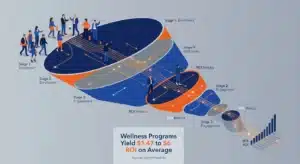
Corporate employee wellness programs represent employer-sponsored initiatives that systematically promote employees’ overall health and well-being across multiple dimensions. These programs employ preventive strategies, educational resources, and personalized interventions to foster sustainable healthy behaviors, manage chronic conditions, and address modern workplace challenges like burnout and hybrid work demands. By integrating physical activity, mental health support, and financial literacy, they deliver measurable benefits such as reduced absenteeism, lower healthcare costs, heightened engagement, and improved retention rates. Recent data underscores their impact: programs yield an average ROI of $6 for every $1 invested, with $3.27 saved per dollar on healthcare alone, alongside 20% productivity gains and 28% fewer sick days. For HR and population health professionals, understanding these programs is essential to building a culture of wellness that drives business outcomes. See the SHRM toolkit on designing effective wellness programs for foundational guidance.
Holistic Approach to Well-Being
A hallmark of effective corporate employee wellness programs is their holistic framework, encompassing physical, mental, emotional, financial, and social dimensions to recognize the interconnected nature of health. Physical well-being initiatives include fitness challenges like step-tracking campaigns and nutrition coaching, with 76% of employers ramping up investments in weight management, often incorporating behavioral support alongside emerging treatments. Mental and emotional support features stress management workshops, mindfulness apps, and virtual therapy access, critical as 66% of workers report burnout impacting performance and 76% of organizations prioritize mental health expansions. Financial well-being tools provide budgeting education, debt counseling, and retirement planning, helping mitigate stress from economic pressures. Social elements promote team-building activities, community networks, and flexible scheduling to enhance work-life balance and foster belonging. This comprehensive strategy not only boosts employee satisfaction, with 89% of participants happier and more likely to recommend their employer, but also strengthens retention by 69%.
Core Components
Robust programs rest on four interconnected pillars: assessments, tailored programs, technology integration, and support structures. Health Risk Assessments (HRAs) and Personal Wellness Assessments (PWAs) pinpoint individual risks through biometric screenings, lifestyle surveys, and stress evaluations, enabling customized action plans with incentives driving high completion rates. Programs deliver variety via challenges, one-on-one coaching, group sessions like yoga, and mobile apps for habit tracking, doubling participation in hybrid formats. Technology amplifies reach with wearables (integrated in 75% of initiatives), AI-driven personalization for workouts or chatbots, and rewards systems that boost engagement by 95%. Support structures ensure success through leadership buy-in, where executive participation models commitment; inclusivity for diverse needs; continuous feedback loops via surveys; and ROI tracking metrics like healthcare savings and productivity. These elements create adaptive ecosystems that evolve with employee needs.
Global Adoption and Evolution
Global adoption reflects maturity: 87% of organizations now maintain formal wellness initiatives, while 83% of medium and large companies deploy structured programs, per 2026 data, up from 61% in 2020. The market, valued at $68.02 billion in 2025, is projected to hit $72.73 billion in 2026. Programs have evolved from basic perks like gym discounts to integrated ecosystems tackling dynamic issues such as chronic disease management (driving 90% of healthcare costs) and post-pandemic mental health priorities. This shift emphasizes personalization via AI and wearables, alongside preventive care, positioning wellness as a strategic imperative for retention and cost control.
Proven ROI and Business Impact
Corporate employee wellness programs deliver measurable returns that directly address rising healthcare costs, boost productivity, and enhance employee retention and engagement. A landmark meta-analysis reveals an average ROI of $6 saved for every $1 invested, with $3.27 stemming from healthcare savings alone and an additional $2.73 from reduced absenteeism. This breakdown underscores how these programs mitigate expenses through preventive care and healthier lifestyles. Notably, 72% of employers report lower healthcare costs post-implementation, as confirmed by industry benchmarks from sources like SHRM and recent surveys. For HR professionals managing population health, this translates to actionable strategies: prioritize programs with integrated assessments and coaching to capture these savings. Platforms like FitLyfe’s adaptive technology enable precise tracking of these metrics, streamlining ROI measurement across diverse workforces.
Productivity gains further amplify the business case. Comprehensive wellness initiatives yield a 20% increase in overall productivity, driven by reduced presenteeism and enhanced focus. Organizations see 28% fewer sick days on average, with participants experiencing a 56% reduction—equating to about 1.5 fewer days per employee annually. These improvements foster a culture of wellness, where engaged employees contribute more consistently. A UnitedHealthcare survey of over 630 U.S. employees highlights how 62% reported higher output and 56% fewer absences tied to program participation. Actionable insight: integrate wearables and AI-driven challenges to target high-risk groups, yielding faster gains in engagement and retention.
The global corporate wellness market reflects this momentum, valued at $72.73 billion in 2026 and projected to reach $138.37 billion by 2035 at a CAGR of 7.36%. North America commands a 40% share, propelled by widespread adoption among large organizations, which account for 64% of end-use. This growth signals confidence in wellness as a retention tool amid talent shortages. Large-scale employers benefit from onsite and virtual models, reducing administrative burdens while scaling impact. For population health managers, this trend advocates investing in flexible platforms that customize solutions, much like FitLyfe’s single ecosystem combining tech security with full-spectrum programs.
Amid these opportunities, 60% of employers plan to increase wellness budgets, countering a 6.5% healthcare cost rise in 2026—the steepest in 15 years. Driven by inflation in services like GLP-1 medications and post-COVID utilization, costs threaten margins without intervention. Mercer’s latest report warns of potential 9% jumps absent proactive measures. Employers responding with holistic programs not only curb expenses but cultivate resilient cultures. A Wellhub study of 2,000+ HR leaders shows 95% measuring positive ROI, with holistic offerings achieving 150%+ returns. Ultimately, these investments in employee health yield sustained engagement, lower turnover, and competitive edges in talent management.
Enhancing Retention and Employee Engagement
Corporate employee wellness programs serve as powerful levers for improving employee retention and engagement, directly addressing the talent challenges faced by HR and population health management professionals. By integrating holistic support through adaptive platforms, these initiatives not only boost morale but also create measurable loyalty, reducing turnover costs that can exceed 1.5 times an employee’s salary. Recent data underscores this impact, with participants experiencing heightened satisfaction and commitment that translates to sustained organizational performance.
89% of Participants Happier and More Likely to Recommend Their Employer; 69% Improved Retention Rates
A striking 89% of employees participating in wellness programs report greater happiness at work and are significantly more inclined to recommend their employer as a great place to work. This advocacy stems from feeling valued through personalized health interventions, fostering a sense of belonging. Complementing this, 69% of HR leaders observe improved retention rates attributable to these programs, as healthier employees demonstrate lower voluntary turnover. For instance, organizations with robust wellness ecosystems see turnover drop by up to 11-30%, enabling HR teams to retain top talent amid competitive labor markets. In population health management, tracking participation correlates directly with these outcomes, providing actionable data for strategic adjustments.
53% Less Likely to Job Hunt; Linked to Engagement via Rewards (88% Usage) and Feedback-Driven Personalization
Employees engaged in wellness programs are 53% less likely to actively job hunt, as comprehensive support signals employer investment in their long-term well-being. This effect intensifies through high-engagement tactics like rewards systems, utilized by 88% of top programs, which include points redeemable for incentives that drive sustained participation rates of 70-88%. Feedback-driven personalization further amplifies this; pulse surveys and AI analytics allow tailoring challenges to individual needs, such as stress management for high-burnout groups. SelectSoftwareReviews employee wellness statistics highlight how these mechanisms yield engagement surges, directly curbing attrition by making employees feel seen and supported.
Fostering Loyalty Through a Culture of Wellness: Addressing Burnout (66% Prevalence, 73% Performance Impact)
Wellness programs cultivate a culture of loyalty by proactively tackling burnout, which affects 66% of employees and impairs performance for 73% of those impacted. By embedding mental health resources, resilience training, and inclusive support structures, companies shift from reactive to preventive strategies, reducing presenteeism and enhancing psychological safety. This cultural integration leads to 81% higher mission commitment among high-wellbeing employees, solidifying retention. HR professionals can leverage leadership buy-in and ongoing feedback to sustain this, transforming wellness into a core value that boosts overall engagement.
Engagement Metrics Tied to Retention in Population Health Management
In population health management, key metrics like 70-88% engagement rates in integrated platforms predict 16-30% retention uplifts, as seen in step challenges and wellbeing score tracking. High utilization of health assessments (61% with strong participation) correlates to 64% loyalty rates, while financial wellness tools enhance feelings of control, tying to lower turnover. ROI metrics, such as $3.27 saved per $1 invested in healthcare, further validate these links, with proactive data analytics enabling targeted interventions. WellSteps employee wellness trends for 2026 emphasize how these benchmarks guide scalable, feedback-optimized programs for enduring impact.
Prioritizing Employee Health Outcomes
Corporate employee wellness programs are increasingly zeroing in on high-impact health outcomes to combat escalating healthcare costs and chronic conditions, which account for 90% of the U.S.’s $4.9 trillion annual spend. With 60% of employers planning budget increases for 2026 amid a projected 6.5% per-employee cost rise, priorities center on mental health, weight management, and preventive care. These targeted investments not only drive engagement and retention but also yield tangible ROI through fewer sick days and absenteeism. HR and population health leaders can leverage adaptive platforms to customize these elements, ensuring measurable improvements in employee well-being.
Mental Health as Top Priority
Mental health tops the list for the seventh straight year, with 76% of employers ramping up investments despite budget pressures. This sustained focus addresses burnout affecting 66% of workers, which 73% say hampers performance. Brokers forecast continued growth, as 86% predict heightened spending through 2025-2026, driven by demands for enhanced Employee Assistance Programs (EAPs), manager training, and telehealth. Recent expansions show 94% of large employers strengthening coverage, yet 59% of workers feel resources fall short. Actionable steps include integrating AI-personalized resilience tools and tracking engagement metrics to bridge awareness gaps. For details, see the Wellable 2026 Trends Report.
Surge in Weight Management Initiatives
Weight management sees parallel momentum, with 76% of employers boosting budgets and benefits growing at a 109% clip. This surge ties to GLP-1 medications like Ozempic, now covered by 55% of plans for diabetes and increasingly for obesity (36% extension). Prescriptions jumped 364% from 2019-2024, prompting 77% of large firms to prioritize cost controls like nutrition coaching mandates. Pairing meds with behavioral support prevents rebound weight gain, aligning with WHO guidelines for holistic obesity management. Employers should audit utilization data and embed lifestyle coaching to maximize sustainability and long-term health gains. Explore trends in the CoreHealth 2026 Report.
Emphasis on Preventive and Chronic Care
67% of organizations are increasing disease management investments, up from 58%, with 68% engaging physicians for population health strategies targeting diabetes and beyond. This shift counters a 10.4% post-pandemic spend rise, favoring coaching and biometrics over traditional screenings. 72% anticipate preventive health growth, yielding savings like $3.78 per $1 invested per RAND studies.
ROI Through Reduced Absenteeism and Sick Days
These priorities deliver clear ROI: participants log 56% fewer sick days, averaging 1.5 fewer per employee annually, with overall absenteeism dropping 14-19%. Stress programs cut related absences by 38-42%. Wellness leaders should prioritize VOI metrics, linking outcomes to retention (9% lower turnover) and productivity (20% gains). By focusing here, programs streamline administration and foster a culture of wellness. See projections in the WTW 2026 Insights.
Building a Culture of Wellness
Building a culture of wellness within corporate employee wellness programs requires deliberate leadership commitment and inclusive strategies that permeate every level of the organization. Leaders must visibly champion these initiatives by participating in activities, allocating budgets, and integrating wellness into key performance indicators. For instance, 94% of CEOs now approve dedicated wellness budgets, tying them to financial success, which fosters authenticity and boosts participation rates. Inclusivity, particularly through a DEIB lens, ensures broad engagement by addressing diverse needs, such as higher chronic disease rates among underrepresented groups; Wellable outlines seven steps, including accessible benefits like fertility support, diverse providers, and culturally relevant promotions. This approach reduces health disparities and enhances psychological safety, with 89% of companies reporting formal DEIB strategies driving innovation.
Sustained culture shifts demand robust feedback mechanisms and employee-centric design. Regular anonymous surveys, pulse checks, focus groups, and health risk assessments gather real-time insights, allowing programs to evolve; only 17% of employers fully leverage these, yet they double participation in hybrid formats. Platforms like FitLyfe’s adaptive single solution enable personalized ecosystems via AI and wearables, incorporating employee input for holistic support across physical, mental, and financial domains. Actionable steps include DEIB scorecards and employee resource groups for inclusive analytics, ensuring voluntariness and incentives like premium reductions comply with ADA and GINA.
This wellness culture directly links to business outcomes, delivering up to 20% productivity gains and stronger retention amid talent wars. Companies see 28% fewer sick days, 69% improved retention, and $6 ROI per $1 invested, with 73% of CEOs noting turnover drops to 9% versus 15% without programs. CoreHealth emphasizes leadership support to avoid superficial efforts.
Embed wellness into values and operations by aligning it with core mission statements, leader storytelling, and daily rituals like “exercise snacks” or team challenges. Unified platforms streamline access, increasing engagement by 48%, while rewards and social events reinforce habits. For HR leaders, prioritize ROI dashboards and preventive tools to measure impact and adapt dynamically.
2026 Trends Reshaping Programs
Holistic and Personalized Ecosystems
Corporate employee wellness programs are transitioning to holistic, AI-driven ecosystems that integrate physical, mental, financial, and social health domains into unified platforms. These systems leverage AI for hyper-personalized experiences, analyzing employee data such as profiles, life stages, and real-time progress to deliver tailored workouts, nutrition plans, and predictive alerts for risks like fatigue or burnout. Wearables play a pivotal role, with spending surging 88% in 2025, enabling gamified tracking of activity, sleep, stress, heart rate variability, and even glucose levels. Bio-monitoring advancements, including neuro-tracking and genetics, provide deeper insights when interpreted by professionals, fostering preventive goals that boost engagement by 62% among weekly app users. For HR leaders, this means prioritizing platforms with seamless wearable integration and human coaching complements to maximize flexibility and outcomes. Actionable insight: Pilot AI personalization with employee feedback loops to achieve 20% productivity gains while reducing healthcare costs by up to 35%.
Mental Health Essentials and Weight Management Integration
Mental health remains the top priority, with 76% of employers increasing investments through upgraded Employee Assistance Programs (EAPs), resilience training, mindfulness apps (covered by 75%), and manager-led stress workshops. These proactive tools address 90% burnout prevalence and 66% performance impacts, evolving from reactive support to “mental fitness” models that include peer groups and exercise for stress relief used by 59% of employees. Concurrently, weight management surges with 76% investment growth, focusing on obesity amid $4.9 trillion chronic care costs; GLP-1 medications like Ozempic see prescriptions up 364% since 2019, covered by 55% of employers when paired with behavioral coaching and dietitians per WHO guidelines. This integration sustains outcomes, managing $1,000 monthly drug costs and shortages through holistic programs. HR professionals should mandate lifestyle requirements for coverage to enhance retention, as 89% of participants report higher happiness. Transitioning to these essentials strengthens culture of wellness and cuts sick days by 56%.
Preventive Care, Ethical AI, and Policy Evolutions
Preventive care leads with 72% investment growth, emphasizing physician engagement (up 68%), early screenings via primary care, and incentives to tackle 90% preventable chronic expenses, moving beyond outdated health fairs. Ethical AI deployment is crucial yet challenging, as 95% of generative AI pilots fail due to data biases, privacy risks, and lacking ROI strategies; only 13% of executives feel prepared, urging HR gatekeeping for secure wellness apps. Policy shifts, including telehealth expansions under acts like OBBB, boost 73% mental health virtual access and hybrid coaching. These elements enable population health managers to measure value on engagement and retention over pure ROI, with 97% of CEOs linking programs to productivity. Implement VOI metrics and ethical frameworks to navigate hype, ensuring inclusive telehealth reduces absenteeism by 67%.
Employee-Centric Innovations Ahead
Looking to 2026, employee-centric shifts prioritize rewards (used by 88%), burnout prevention via recharge spaces and energy-balance programs (89% better performance), and inclusive designs for hybrid workers, diverse life stages, and DEIB needs (26% cultural focus). Social connections through team activities (preferred by 83%) and gamification drive weekly app use, while leadership buy-in (72%) and feedback collection (only 17% currently) amplify utilization. With 60% budget increases amid 6.5% healthcare rises, unified platforms will mature AI ethically, standardize GLP-1 with coaching, and foster hybrid inclusivity for 73% retention boosts. For success, embed feedback-driven customization and balance tech with human elements. Explore detailed forecasts in Wellhub’s corporate wellness trends and NIS Benefits’ 2026 predictions to position your program for transformative impact.
Technology and Platform Strategies
Platforms vs. Portals: Prioritizing Adaptive Single Platforms
In corporate employee wellness programs, the distinction between fragmented portals and adaptive single platforms is critical for achieving scalable, integrated outcomes. Portals often function as basic dashboards that handle reimbursements or isolated challenges, leading to administrative silos, multiple logins, and disjointed data flows that hinder engagement. Adaptive single platforms, such as FitLyfe’s solution, consolidate all wellness pillars into one secure, customizable hub. This enables HR professionals to tailor branding, role-based access, and personalized health journeys without vendor lock-in. Secure integrations with HR systems, biometrics, and coaching services streamline administration, reducing overhead by centralizing real-time data processing. As healthcare costs rise 6.5% in 2026, these platforms support population health management by evolving with hybrid workforces, delivering 64% higher engagement through unified mobile access.
Essential Features Driving Impact
Key features in advanced platforms like FitLyfe empower precise wellness interventions. Proprietary AI delivers personalization, such as adaptive workout plans, predictive risk alerts from wearable data, and chatbots for mental health triage, addressing the 95% AI pilot failure rate through ethical, ROI-focused implementation. Wearables synchronization with devices like fitness trackers captures real-time activity metrics, fueling gamified challenges that boost adoption by 75% and reduce sick days by 28%. Robust ROI tracking tools analyze population health metrics, including absenteeism reductions (up to 18%), chronic condition management, and per-employee savings of $264 annually. These dashboards leverage pre- and post-program biometrics alongside transtheoretical behavior models to quantify $3.27 in medical savings per $1 invested. For population health leaders, this visibility ties directly to productivity gains of 20% and retention improvements.
Differentiation Through Flexibility and Privacy
FitLyfe stands out with unmatched flexibility for emerging trends, such as GLP-1 coaching for weight management, where 76% of employers are increasing investments amid a 364% prescription surge since 2019. Its modular coaching dashboard, HIPAA-compliant and integrated with care coordination, supports lifestyle programs required by 34% of firms covering these high-cost medications (around $1,000 monthly). Unlike fragmented systems prone to data silos, this single platform ensures seamless adaptation to holistic needs like mental health and chronic care, minimizing persistence issues where only 1 in 12 users continue without behavioral support. Data privacy is fortified with federal regulations, HITRUST-level security, and centralized controls, safeguarding sensitive biometrics amid rising AI and wearable risks. This approach fosters trust, essential as 66% of employees report burnout impacting performance.
Strategic Evaluation Recommendations
When selecting a corporate employee wellness program platform, prioritize engagement tools like customizable challenges, rewards systems (adopted by 88%), and feedback surveys to lift participation by 70%. Assess scalability for workforces from 25 to over 20,000 via modular designs and SSO integrations. Demand outcomes measurement through VOI/ROI dashboards tracking health risks, energy levels, and turnover. Conduct demos focused on real-time analytics and leadership buy-in to align with 2026’s $100 billion market growth. FitLyfe exemplifies these criteria, positioning HR teams to maximize retention, cut costs, and cultivate wellness cultures effectively.
Actionable Takeaways for HR Leaders
HR leaders can drive transformative results in corporate employee wellness programs by following these streamlined steps. First, conduct a Population Wellness Assessment (PWA) to baseline employee health data, revealing hotspots like the 66% burnout rate impacting performance. Next, select an adaptive single platform that integrates wearables, AI personalization, and programs for flexibility. Prioritize surging trends: mental health, where 76% of employers are boosting investments for 20% productivity gains, and weight management, with 76% increasing focus amid a 109% rise in related benefits. Finally, measure ROI through retention metrics (69% improvement) and health outcomes, targeting $3.27 saved per $1 spent on healthcare amid 6.5% cost hikes in 2026.
Essential Implementation Checklist:
- Secure leadership buy-in by linking programs to $6:$1 ROI and 28% sick day reductions.
- Ensure inclusivity via DEIB-focused designs, accommodating diverse needs.
- Integrate feedback loops and AI ethically, avoiding the 95% pilot failure rate through transparent data policies.
Pilot customized programs with FitLyfe-like adaptive platforms to achieve measurable gains: heightened engagement (89% happier employees), a robust wellness culture, and slashed costs. Download our 2026 trends report or schedule a demo today for population health optimization.
Conclusion
Corporate wellness programs deliver transformative results for retention and ROI. First, they slash turnover rates by 25-50%, saving companies up to 200% of an employee’s salary in replacement costs. Second, productivity soars while healthcare expenses drop, as evidenced by Gallup and the Wellness Council of America. Third, comprehensive initiatives like mental health support and stress management build engaged, loyal teams. Finally, these investments yield measurable returns that strengthen organizational health.
Do not wait for talent to walk out the door. Assess your current wellness offerings today, then invest in a tailored program to unlock these benefits. Embrace wellness as your strategic edge. Your workforce, and your bottom line, will thrive in a culture of vitality and commitment. The future of retention starts now.
(128 words)